Tussar Silk Saree: What It Is, Why It's Unique, and How to Wear It
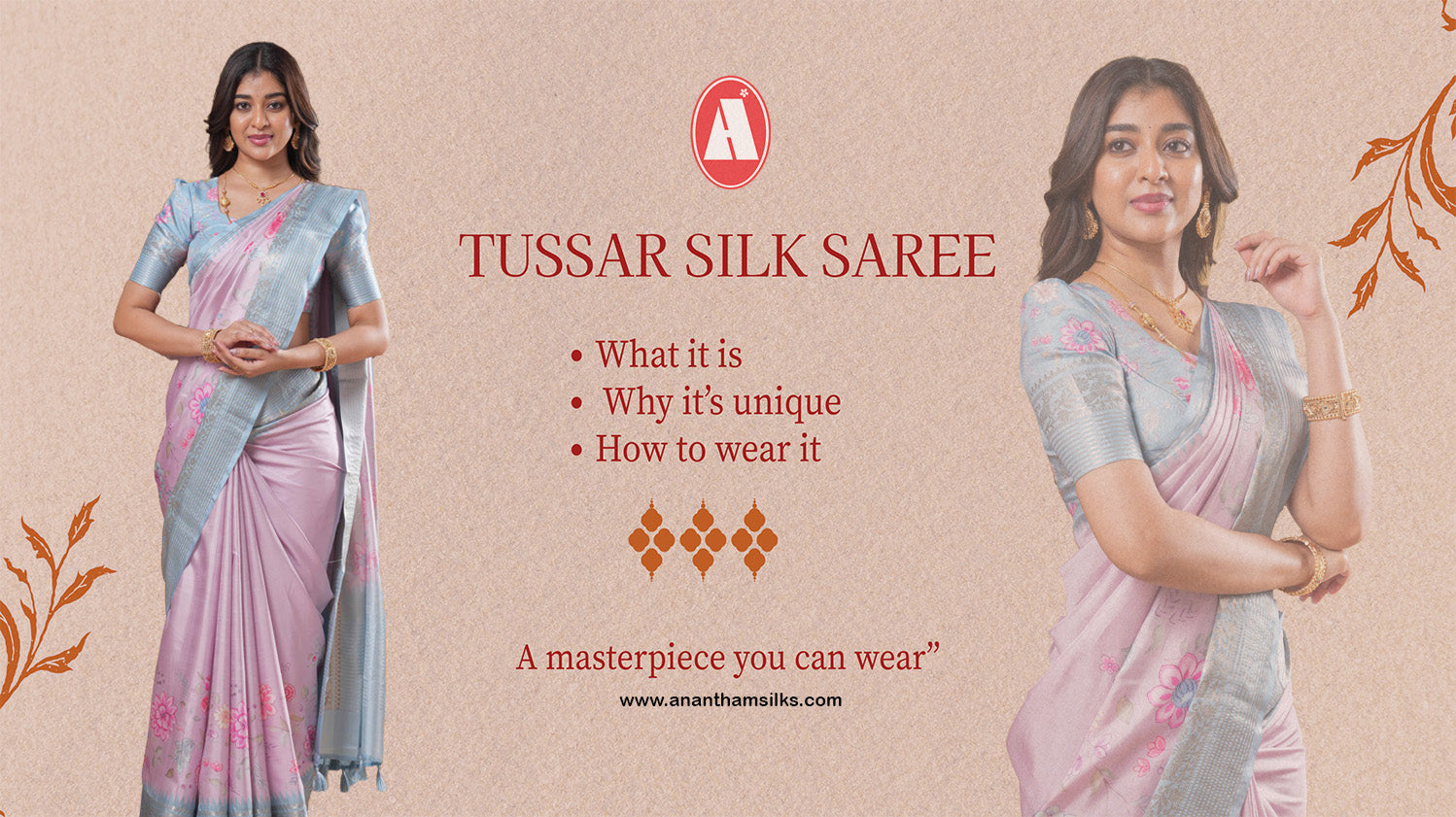
Tussar silk is not farmed. That is the first thing worth knowing. Picture wild silkworms feeding on Sal and Arjun trees, in eastern Indian forests. Tussar silk comes from that process and eventually the saree carries a texture, colour, and character no cultivated silk can replicate. This tussar silk saree complete guide for India covers what makes tussar silk saree different from other silks, how to wear it, and why buyers keep returning to it.
What is Tussar Silk? India's Wild Silk Explained
The wild has our heart and so does this silk which is not farmed. The Antheraea silkworm lives wild in eastern Indian forests, feeding on Sal, Arjun, and Jamun trees rather than mulberry leaves in a controlled shed. Jharkhand, Bihar, Chhattisgarh, Odisha, and West Bengal. That is where Indian tussar mostly comes from.
Some buyers know it as kosa silk. The tussar silk aka ‘kosa’ silk means cocoon silk in Sanskrit, where Kosa simply means cocoon. India is the world's second-largest tussar producer. The wild harvest process also leaves a minimal environmental footprint, which is worth noting.
What Makes Tussar Silk Sarees Unique?
Tussar silk saree texture and characteristics are not subtle. You notice them the moment you pick one up in a shop. Six things that set it apart:
● Natural golden hue: Warm beige or golden tone from forest origin | No synthetic replicates this colour
● Grainy surface: Shorter irregular fibres create visible texture | Mulberry silk is smooth by comparison
● Matte sheen: Earthy warm lustre, not the high gloss of Kanchipuram | More understated for everyday wear
● Lightweight: Lighter than Kanchipuram despite the textured surface | Comfortable across long events
● Superior dye absorption: Holds natural and printed dyes deeply | Ideal for kalamkari and warli printing
● Eco-sustainable: Wild harvest, zero farm cultivation | An honest claim, not marketing language
Pure tussar silk saree qualities make it the natural choice for artisanal printed sarees. The earthy base colour and rough surface hold folk art prints in a way smooth silks simply cannot.
Tussar Silk vs Mulberry Silk vs Kanchipuram Silk
The difference between tussar silk and mulberry silk sarees is most visible in texture and occasion.
Fabric Texture Sheen Tussar Saree Silk Grainy, earthy Matte lustre Best For gold Casual Price Range to Rs. 800 - semi-formal Mulberry Soft Silk Kanchipuram Silk / High gloss Smooth, uniform Heavy, structured Deep sheen All occasions rich Weddings, formal Tussar Silk Sarees and Indian Art Traditions 8,000 Rs. 1,500 - 12,000 Rs. 10,000+
Tussar Silk Sarees and Indian Art Traditions
Having a rough exterior is not a defect of tussar, and folk artists appreciate this quality. Compared to other silks, tussar holds naturally dyed prints more sharply and deeply.
Using Kalamkari tussar silk sarees as an example, you will find a striking contrast between the earthy tones of the fabric and the undyed backgrounds utilized to make temple scene prints. Similarly, you will find a very photogenic combination of tussar and Warli art, prints using white tribal geometry over beige tussar. Finally, Village art or Madhubani prints have a beautiful longevity on tussar silk compared to other silks.
Anantham carries Kalamkari-style tussar and Warli print tussar sarees. Handloom tussar silk saree with hand-painted design is what many customers come in specifically looking for. No mainstream competitor stocks this range or depth.
How to Style a Tussar Silk Saree
Tussar saree styling jewellery blouse ideas start with one rule: avoid modern fashion jewellery. How to wear a tussar silk saree for different occasions is really about reading the setting and dressing the print, not overshadowing it.
● Casual or office | Plain or lightly printed tussar | Simple blouse | Small studs or jhumkas | Flat sandals
● For festive or cultural looks | Choose Kalamkari or Warli printed tussar | Style with silver or antique gold oxidised jewellery | Let the print lead
● Wedding guest | Tussar with zari border in jewel tones | Temple jewellery | Silk or brocade blouse
How to Identify Pure Tussar Silk An original tussar silk
saree vs synthetic is easy to spot with a few quick checks. How to identify pure tussar silk saree test:
● Visual texture | Real tussar has a textured grain | Synthetic fabrics are too even, too smooth
● Color | Naturally occurring tussar has a color range of warm beige to subtle gold | Bright, unnaturally occurring white colors are indicative of bleaching or synthetic fabrics
● Burn test | Lightly pull a thread and set it on fire | Real tussar remains a brittle ash and has a hair smell | Synthetic fabrics melt into beads
● Weight | Heavier than chiffon, lighter than Kanchipuram | Uniform lightness across the whole saree is a warning sign
● Drape test | Pure tussar holds pleats with slight stiffness | Synthetic drapes too softly or too rigidly
Tussar Silk Saree Care and Maintenance
How to wash a tussar silk saree at home and how to store a tussar silk saree properly are both simpler than most buyers expect:
● Washing | Dry clean for printed or embellished tussar | Plain tussar: cold water hand wash with mild shampoo | Never machine wash
● Drying | Flat in shade only | Wringing or hanging both damage the fibre structure
● Ironing | Low to medium heat on reverse side | Cotton press cloth between iron and fabric | Never iron printed areas directly
● Storage | Fold in muslin or cotton cloth | Neem leaves deter moths | Air the saree periodically | Never seal in plastic
Tussar silk sarees with prices at the handloom end of the market are worth protecting properly. Good storage adds years of wearable life.